
Solitaire.com - Classic Cards
Tripledot Studios LimitedCard
4.763.44K Reviews
- Version
- 4.65.00
- Installs
- 50.00M
- Age Rating
- Everyone
Screenshots
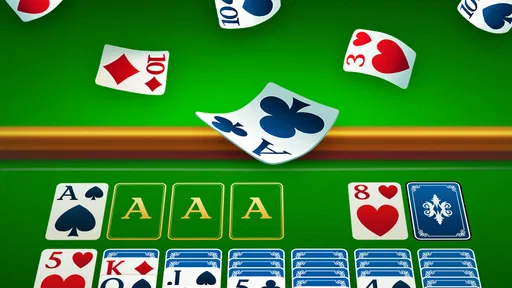
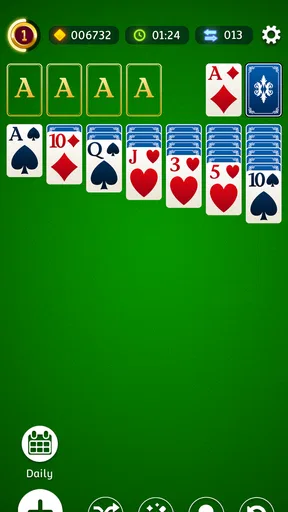
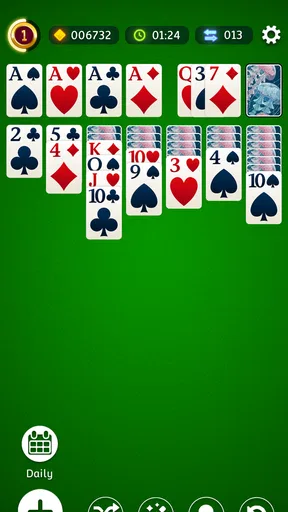
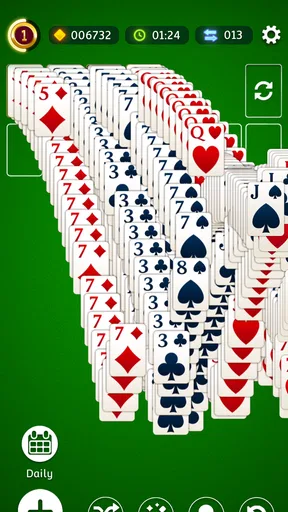
Play Needledrop


Our Review of Solitaire.com - Classic Cards
 Analysis by Appyee
Solitaire.com - Classic Cards is the kind of game I open when I want something familiar, quiet, and easy to start without committing to a long session. It is a free card game from Tripledot Studios Limited, built around solitaire rather than a large collection of complicated modes. My overall view is positive: it is polished enough for everyday play, approachable for beginners, and flexible enough to become a small part of a routine. At the same time, its simplicity is also its main limitation. Players looking for deep strategy, strong social competition, or a constantly changing adventure may find it too restrained.
The clearest reason to try it is that it removes most of the effort between deciding to play and actually making the first move. I do not need to learn an elaborate ruleset or prepare for a match against another person. The card layout gives me a short mental task, and I can stop after one deal without feeling that I have abandoned a larger campaign. That makes it especially comfortable for small breaks, waiting rooms, or the final few minutes before bed.
Why this solitaire game works so well in ordinary moments
Solitaire is often treated as background entertainment, but a good version depends on details that are easy to overlook. Cards must be readable, taps must feel deliberate, and the game has to make the next decision obvious without making every decision for me. In my experience, this title succeeds because its central idea stays focused: arrange cards, look for the next useful move, and keep the board moving toward completion.
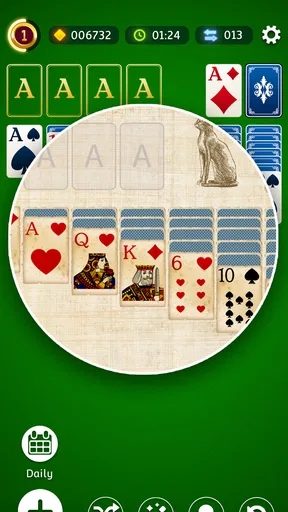
The appeal is not only nostalgia. A traditional solitaire layout gives me a gentle combination of pattern recognition, planning, and patience. I am constantly choosing between exposing a hidden card, moving a visible sequence, or preserving an option for later. The decisions are small, but they create enough tension to keep a short session from feeling completely passive. When I make a mistake, I usually understand why the position became difficult, which is more satisfying than losing for a reason hidden behind complex rules.
That balance also explains why the game can suit different levels of experience. Someone who has barely played card games can learn by following the visual structure of the board. A more practiced player can think several moves ahead and try to avoid closing off useful columns. I would not call the strategy exceptionally deep, but it has more texture than simply matching pairs or tapping whatever is highlighted.
The game’s broad reach supports that impression. It has passed 50 million installs and holds a 4.7 average from around 326 thousand ratings, which suggests that the straightforward format has connected with a very large audience. Those figures do not replace personal testing, but they do place this release among the better-known casual card choices rather than an obscure experiment.
A useful game for short, interrupted sessions
My favorite way to use it is in fragments. Imagine having ten minutes before an appointment: I can begin a deal, make a few careful moves, and either finish or leave it when my name is called. The game works particularly well in that situation because the objective remains clear even if I am not fully absorbed. It does not demand a headset, a group of friends, or a long explanation before the first turn.
That same quality helps when I want a screen activity that is calmer than an action game. Solitaire gives my attention somewhere to go without filling the room with noise or asking me to react quickly. The mental rhythm is steady: inspect the tableau, identify a legal move, consider what it reveals, and reassess the board. I find that rhythm more relaxing than competitive mobile games, especially when I am already tired.
There is also value in using a deal as a small concentration exercise. Instead of tapping rapidly, I can pause before moving a card and ask what the move will make possible. This turns a casual round into a modest planning routine. It is not a substitute for a dedicated puzzle or brain-training program, and I would be skeptical of exaggerated claims about improving intelligence, but it does encourage attention and sequential thinking in a simple format.
What the developer gets right
Tripledot Studios Limited has chosen a sensible level of accessibility for a game intended for a wide audience. The content rating is Everyone, and the game does not rely on mature themes or an intimidating presentation to create interest. That makes it easy to recommend across a household, including to someone who wants a familiar card pastime rather than a demanding new hobby.
The free price is another practical advantage. I can install it and decide whether the card layout suits me without paying at the beginning. That matters in this category because many people already know what kind of solitaire experience they want: some prefer a bare table and nothing else, while others enjoy a more decorated, guided presentation. A free starting point makes testing less of a gamble.
The release has also had time to mature. It first appeared on January 19, 2018, and the current version is 4.63.01. I see that history as useful rather than merely promotional: a long-running card game has had more opportunity to settle its basic presentation and remain compatible with ordinary mobile use. Devices running Android 7.1 or later can use it, so owners of older supported phones are not automatically pushed toward a newer handset.
One subtle strength is how little emotional pressure the core activity creates. In many mobile games, every session is tied to a reward track, a ranking, or a limited event. Here, the main satisfaction comes from improving the position in front of me. That makes the app a better fit for people who want an uncomplicated pastime and a worse fit for anyone who needs constant novelty to stay interested.
The small decisions that improve the experience
New players often move the first available card immediately, but I get better results by looking at the whole tableau before touching anything. The first useful question is not “What can I move?” but “Which move reveals information?” Exposing a hidden card can be more valuable than building a neat-looking sequence, because new information may open several later choices.
I also try not to send every eligible card to the foundation as soon as possible. Moving cards upward feels productive, yet keeping a low card available in the tableau can sometimes preserve access to a hidden column or support another sequence. This is one of the more interesting trade-offs in a basic solitaire game: the most obvious legal move is not always the most helpful one.
Another practical habit is to treat empty spaces as valuable rather than simply convenient. A vacant column can give me room to move a longer sequence and expose cards that were blocked. If I create that space too early without a plan, however, I may have nowhere useful to place it. I recommend using an empty column with a purpose in mind, not just because the option is available.
For a more thoughtful session, I sometimes play without rushing to undo a questionable move. That makes the result feel more like a planning exercise and helps me notice the point where the board became restricted. On other days, I prefer a lighter approach and simply restart when the layout stops being enjoyable. The app supports both moods because the basic loop is understandable even when I am not trying to optimize every deal.
Where the simplicity becomes a limitation
The biggest weakness is that the experience can become repetitive. The same fundamental card arrangement and decision cycle are exactly why the game is approachable, but they also place a ceiling on long-term variety. I can enjoy several rounds during a break, yet I do not always want to spend an entire evening with it. Players who need new mechanics, story progression, or a strong sense of collection may run out of motivation quickly.
This is also not the best choice for someone who wants a competitive card environment. The attraction here is personal concentration, not the pressure of facing a human opponent. If your ideal game involves reading another player, building a deck, or comparing detailed performance with friends, a multiplayer card title would probably serve you better. Solitaire.com - Classic Cards is deliberately more solitary in both the literal and practical sense.
Its casual nature can create another kind of friction: the game is easy to pick up but not necessarily easy to master. A beginner may expect every deal to be solved if they simply follow the legal moves, then become frustrated when an earlier decision leaves the board awkwardly arranged. The solution is to slow down and think about card access, not merely available moves. Still, the app could feel less rewarding to people who prefer clearly measurable progression.
I would also avoid choosing it solely because of the store summary’s suggestion that solitaire can boost IQ. I see genuine value in the attention and planning involved, but a few card rounds should be understood as entertainment with a light cognitive challenge, not as a scientifically defined training program. That distinction matters if you are comparing it with an app designed specifically for structured exercises.
How it compares with other ways to play cards
Compared with a physical deck, this game is more convenient and less tactile. I do not need a table, I cannot accidentally scatter the cards, and the app lets me play whenever my phone is nearby. The trade-off is that digital play lacks the satisfying act of dealing and physically moving a card. If the ritual matters as much as the puzzle, a real deck may remain more enjoyable.
Compared with a very minimal solitaire app, this title is likely to feel more welcoming to people who appreciate a guided mobile presentation. A stripped-down alternative may be preferable if you want almost no visual extras and the smallest possible footprint in your attention. I would choose this release when I want a ready-to-play experience rather than a digital equivalent of an empty card table.
Compared with collectible card games, it is much easier to understand and far less demanding of time. There is no need to learn a large card pool before making sensible decisions. The downside is that it does not offer the deck-building creativity or changing matchups that keep those games fresh. Choosing between them depends on whether you want a self-contained puzzle or an evolving competitive system.
Against puzzle games with levels and explicit goals, solitaire feels more open-ended. A level-based game can give me a stronger feeling of advancement, while this one gives me a more repeatable ritual. I prefer the solitaire format when I want to play at my own pace and stop naturally. I would select the level-based alternative when I need a clear challenge ladder to maintain interest.
Who should install it, and who should skip it
I would recommend it to people who enjoy classic card rules, want a free casual game, or need something that fits around an unpredictable schedule. It is particularly suitable for players who prefer calm concentration over reflexes and for beginners who do not want a complicated tutorial before starting. Its Everyone rating also makes it a comfortable choice for a broad family audience.
It is less suitable for players who dislike repetition, expect a story, or need constant social interaction. If you want a game that rewards a long-term collection, changes dramatically from session to session, or places you in direct competition, this should not be your first choice. The same focused design that makes it accessible may feel narrow after the novelty wears off.
Before installing, I would ask myself one simple question: do I enjoy making small tactical decisions with familiar rules? If the answer is yes, the free download is an easy experiment. If I mainly want spectacle, narrative, or a powerful sense of progression, I would spend my time elsewhere rather than expecting a traditional solitaire game to become something it is not.
My final assessment
After using it as a casual card companion, I see Solitaire.com - Classic Cards as a dependable rather than ambitious game. It does not need elaborate systems to justify its place on a phone. Its strength is the clean loop of observing, planning, moving, and occasionally starting again. That loop is especially effective when I have only a few minutes and want entertainment that does not demand full commitment.
The audience response is substantial, with over 63 thousand written reviews and a free entry point that makes the game easy to try. For me, the important question is not whether it offers endless variety; it does not. The better question is whether its familiar format remains pleasant after the first few rounds. I think it does, provided I treat it as a short, repeatable pastime rather than a game meant to occupy every evening.
My recommendation is clear: install it if you want approachable solitaire for quiet breaks, light planning, and flexible sessions. Keep your expectations focused on a polished card routine, not a deep strategy campaign or social competition. Within that boundary, it is an enjoyable and sensible choice, and its restraint is more of a strength than a weakness for the right player.
Privacy and Permissions
See what permissions an app requests and how it handles your data.
- Photos/Media/Files
- read the contents of your USB storage, modify or delete the contents of your USB storage
- Storage
- read the contents of your USB storage, modify or delete the contents of your USB storage
- Wi-Fi connection information
- view Wi-Fi connections
- Other
- view network connections, full network access, control vibration, prevent device from sleeping, Google Play license check
Verdict
Strengths of Solitaire.com - Classic Cards
- Simple rules make it easy for beginners to start playing.
- Quick games are convenient for short breaks or casual sessions.
- Classic card layouts feel familiar to traditional solitaire players.
- Runs smoothly on most modern Android and iOS devices.
- Useful for relaxing without requiring competitive multiplayer skills.
Limitations of Solitaire.com - Classic Cards
- Frequent ads may interrupt play, especially between rounds.
- Some features may require payment or in-app purchases to unlock.
- Limited variety compared with larger collections of card games.
- Gameplay can become repetitive after extended sessions.
- An internet connection may be needed for certain features or ads.
Other Releases by Tripledot Studios Limited
View All
Woodoku - Wood Block Puzzle
Puzzle4.2

Get Color - Water Sort Puzzle
Puzzle4.8

Nut Sort: Color Sorting Game
Puzzle4.8

Car Out! Traffic Parking Games
Puzzle4.7
Similar Picks in This Category
View All
Solitaire - Classic Card Games
MobilityWare4.6

UNO!™
Mattel163 Limited4.3

Spider Solitaire: Card Games
MobilityWare4.6

Plants vs. Zombies™ Heroes
ELECTRONIC ARTS4.1

Hearthstone
Blizzard Entertainment, Inc.4.1

Yu-Gi-Oh! Duel Links
KONAMI4.4
Frequently Asked Questions
What is Solitaire.com - Classic Cards?
Solitaire.com - Classic Cards is a digital version of the classic solitaire card game, primarily focused on Klondike-style gameplay. After testing it, I found it easy to start a traditional one-player game, with familiar card layouts and straightforward controls. It is designed for casual sessions, whether you want to play for a few minutes or spend longer improving your strategy and completion time.
How do you play Solitaire.com - Classic Cards?
The main objective is to move all cards to the foundation piles, arranging each suit from Ace through King. Cards in the tableau are generally placed in descending order with alternating colors, while face-down cards can be revealed as you make moves. The app provides a familiar tap-and-drag experience, although the exact controls and available assistance may vary depending on the device and version.
Does Solitaire.com - Classic Cards work offline?
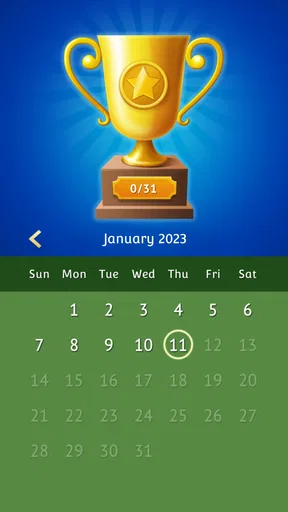
The core solitaire experience may be playable without a constant internet connection, which is useful when traveling or when mobile data is limited. However, features such as advertisements, online statistics, daily challenges, synchronization, or other connected services may require internet access. I recommend opening the game once while connected and checking which features remain available after temporarily disabling your connection.
Is Solitaire.com - Classic Cards free to download and play?
Solitaire.com - Classic Cards is generally available as a free download, allowing users to begin playing without purchasing the basic game. Like many free card games, it may include advertising or optional features that support the developer. Before installing, check the current store listing for in-app purchase details, advertising information, supported devices, and any changes introduced by the latest update.
Is Solitaire.com - Classic Cards suitable for beginners?
Yes, the game is suitable for beginners because solitaire rules are familiar and the interface is usually simple to understand. New players can learn by following the standard card arrangement and experimenting with legal moves. More experienced users may enjoy focusing on faster completions, better decision-making, and challenge-based play. Reviewing the help options is worthwhile if you are unfamiliar with Klondike rules.
Play our best games!


